
Master IGCSE History — from Form 1 to Exam Hall
A syllabus-aligned programme that takes you step by step through every key topic — WWI, Nazi Germany, the Cold War, and beyond — and arms you with the source skills and essay technique to walk into Paper 1 and Paper 4 with real confidence.

"Knowing history isn't enough — I'll show you how to think, argue, and write like an examiner expects, so no question catches you off guard."
— Renstay College
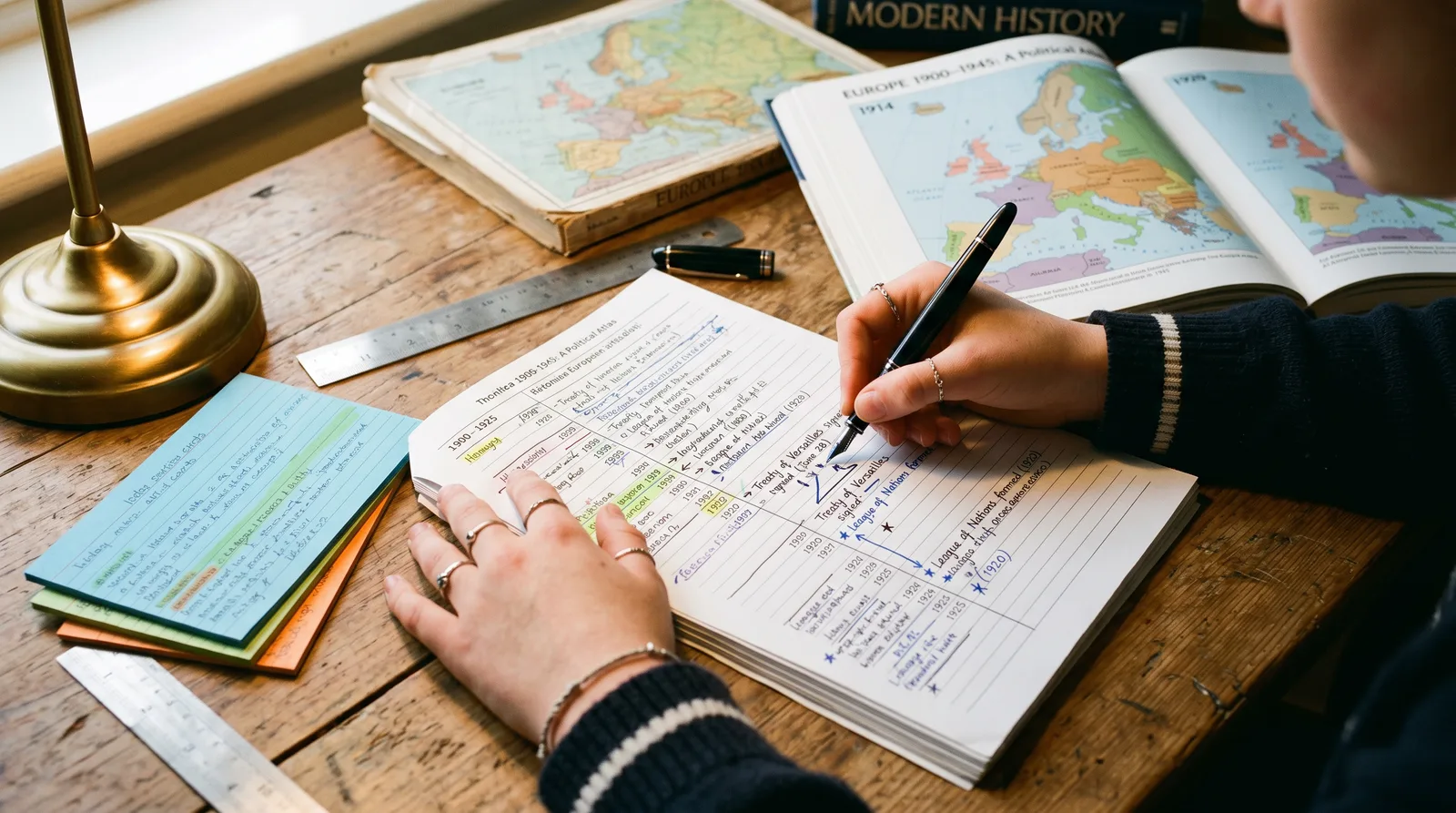
What you'll learn
What you'll be able to do
- Demonstrate a confident command of all key topics on the Cambridge IGCSE History syllabus from Form 1 to Form 4
- Construct well-argued, evidence-based historical essays and source-analysis responses in the IGCSE exam format
- Analyse and evaluate primary and secondary sources for reliability, utility, and historical significance
- Explain the causes, events, and consequences of major 20th-century turning points covered in the syllabus
- Apply key historical concepts — causation, consequence, change, continuity, and significance — to unseen material
- Approach IGCSE History Paper 1 and Paper 4 with proven exam technique and time-management strategies
How it works
A school that adapts to you
This isn't a set of static videos. Every lesson is generated live and tuned to where you actually are.
We learn your level
A quick placement check tailors your starting point so you're never bored or lost.
Lessons adapt as you go
Each lesson is written for your pace and your goal, adjusting as your skills grow.
Your AI coach keeps you moving
Checkpoints, feedback, and gentle nudges turn progress into a real result.
The curriculum
What's inside your school
33 modules · 139 lessons

Thinking Like a Historian: Foundations of Historical Enquiry
Introduces the discipline of history, its core concepts, and the skills underpinning all IGCSE study.
- 1.1What is History and Why Does It Matter?Included
- 1.2The Language of History: Key ConceptsIncluded
- 1.3Working with Sources: An IntroductionIncluded
- 1.4Chronology, Context, and Historical PeriodsIncluded
The World in Turmoil: WWI, Its Origins, and Aftermath
Examines the causes, course, and consequences of the First World War and the peace settlements that followed.
- 2.1The Long and Short-Term Causes of WWIIncluded
- 2.2The War Experienced: Key Events and Turning PointsIncluded
- 2.3The Paris Peace SettlementsIncluded
- 2.4The Impact of WWI on Different NationsIncluded
Dictatorship and Democracy: The Inter-War World (1919–1939)
Covers the rise of dictatorships, the failures of the League of Nations, and the road to WWII.
- 3.1The Rise of Hitler and Nazi GermanyIncluded
- 3.2Life in Nazi GermanyIncluded
- 3.3Stalin and the Soviet UnionIncluded
- 3.4The League of Nations: Aims, Successes, and FailuresIncluded
- 3.5The Road to WWII: Appeasement and AggressionIncluded
A World at War Again: WWII and Its Global Consequences
Studies the causes, key events, and far-reaching consequences of the Second World War.
- 4.1The Course of WWII: Key Theatres and Turning PointsIncluded
- 4.2The Holocaust and War CrimesIncluded
- 4.3The Atomic Bomb and the End of WWIIIncluded
- 4.4The Consequences of WWII: A Changed WorldIncluded
The Cold War World: Superpower Rivalry and Global Tensions
Covers the origins, key crises, and eventual end of the Cold War as required by the IGCSE syllabus.
- 5.1Origins of the Cold War (1945–1949)Included
- 5.2Cold War Crises: Berlin, Korea, and CubaIncluded
- 5.3The Arms Race and the Space RaceIncluded
- 5.4Détente and the End of the Cold WarIncluded
IGCSE Exam Mastery: Source Skills and Essay Technique
Develops the exam-specific skills needed to excel in Cambridge IGCSE History Paper 1 and Paper 4.
- 6.1Analysing Sources for Reliability and UtilityIncluded
- 6.2Cross-Referencing and Comparing SourcesIncluded
- 6.3Writing the IGCSE Historical EssayIncluded
- 6.4Paper 1 and Paper 4: Format, Timing, and StrategyIncluded
- 6.5Full Mock Practice and Examiner FeedbackIncluded
Were the revolutions of 1848 important?
The nature of revolutions in 1848 and the influence of liberalism and nationalism
• Causes, events and results of revolutions in:
– France
– Italy
– Germany
– the Austrian Empire
• Reasons for the failure of the revolutions
- 7.1Why had liberalism and nationalism grown in influence by 1848?Included
- 7.2Why were there so many revolutions in 1848?Included
- 7.3Did the revolutions have anything in common?Included
- 7.4Why did most of the revolutions fail?Included
- 7.5Did the revolutions change anything?Included
How was Italy unified?
Austrian influence over Italy
• Italian nationalism and the role of Mazzini
• Events of 1848–49
• Victor Emmanuel II and Cavour: the agreement of Plombières, war with Austria in 1859
• Garibaldi and the invasion of Sicily and Naples
• The creation of the Kingdom of Italy, completion of unification by 1870
- 8.1Why was Italy not unified in 1848–49?Included
- 8.2How important was Garibaldi’s contribution to unifying Italy?Included
- 8.3Did Cavour help or hinder the unification of Italy?Included
- 8.4How important for other European countries were moves towards Italian unification?Included
How was Germany unified?
German nationalism
• The Zollverein
• The 1848 revolution in Prussia
• The setting up and eventual failure of the Frankfurt Parliament
• Re-establishment of Austrian influence in Germany by 1850
• Bismarck as Prussian Minister–President
• Bismarck’s foreign policy to 1871:
– Schleswig-Holstein
– the Austro–Prussian War and its consequences
– relations with France
– the Spanish Succession and the Franco–Prussian War
– the creation of the German empire
- 9.1Why was Germany not unified in 1848–50?Included
- 9.2How did Bismarck bring about Austria’s defeat of 1866?Included
- 9.3How did Bismarck bring about France’s defeat of 1870?Included
- 9.4How far was Bismarck responsible for the unification of Germany?Included
Why was there a civil war in the United States and what were its results?
Causes and consequences of the American Civil War, 1820–77:
– differences between North and South
– slavery, slave states and free states, abolitionism
– the 1860 election and secession of the Southern states
– reasons for the North’s victory and the South’s defeat
– the role of Lincoln
– reconstruction and the extent of its success
- 10.1How far did slavery cause the Civil War?Included
- 10.2What was the significance of Lincoln’s election as president?Included
- 10.3Why was the North able to win the war?Included
- 10.4Did the war change anything?Included
Why, and with what effects, did nations gain and expand their overseas empires in the nineteenth century?
• Reasons for imperialism: economic, military, geopolitical, religious and cultural motives
• Europeans in Africa: case studies of French, British and Belgian imperialism, and their impacts on
Africans:
– the French model of assimilation and direct rule; Faidherbe and Senegal
– the British model of indirect rule; Lugard and Nigeria
– the Belgians and private imperialism; Leopold II and the Congo
• The British in India: the events of 1857 and the changes they brought to British rule
• Wars of independence in the Philippines and Cuba, the Spanish–American War and the Treaty of Paris:
– the debate in the USA over US imperialism
– the Philippines; consequences of American control on the Filipinos
– American intervention in Cuba to 1906
- 11.1What were the motives behind European and US imperialism?Included
- 11.2How varied were the impacts of European imperialism on Africans?Included
- 11.3Why, and with what effects, did Indians resist British rule?Included
- 11.4NeWhy, and with what effects, did Indians resist British rule?Included
What caused the First World War?
The origins of the First World War, 1890–1914:
– the Alliance System and the European diplomatic system
– the 1902 Anglo–Japanese Alliance
– the arms race
– colonial rivalries
– developments in the Balkans
– the crisis of June–July 1914 and the outbreak of war
- 12.1Did the Alliance System and global diplomacy make war more likely or less likely?Included
- 12.2How far did colonial problems create tensions between the Great Powers?Included
- 12.3Why were problems in the Balkans so difficult for the Great Powers to solve?Included
- 12.4How did the assassination of Franz Ferdinand lead to war?Included
Was the Treaty of Versailles fair?
• The roles of Wilson, Clemenceau and Lloyd George in the peacemaking process
• The terms of the Treaty
• Social, economic and political impact of the Treaty in Germany to the end of 1923
• Contemporary opinions about the Treaty
- 13.1What were the motives and aims of the Big Three at Versailles?Included
- 13.2Why did the victors not get everything they wanted?Included
- 13.3What was the impact of the Treaty on Germany up to the end of 1923?Included
- 13.4Could the Treaty be justified at the time?Included
To what extent was the League of Nations a success?
• The structure, aims and membership of the League
• Successes and failures in peacekeeping during the 1920s:
– Vilna 1920
– Aaland Islands 1920–21
– Corfu 1923
– Bulgaria 1925
• The League’s humanitarian work:
– refugees
– health
– working conditions
– slavery
• The League in the 1930s:
– causes, events and consequences of the Manchurian crisis and of the Abyssinian crisis
- 14.1How far did weaknesses in the League’s organisation and membership make failure inevitable?Included
- 14.2How successful were the League’s attempts at peacekeeping in the 1920s?Included
- 14.3How important was the League’s humanitarian work?Included
- 14.4How far did the Depression make the work of the League more difficult in the 1930s?Included
How far was Hitler’s foreign policy to blame for the outbreak of war in Europe in 1939?
• Hitler’s foreign policy aims
• Rearmament
• The Saar
• Remilitarisation of the Rhineland
• The Rome–Berlin Axis and the Anti-Comintern Pact
• German and Italian involvement in the Spanish Civil War
• Anschluss with Austria
• The crisis over Czechoslovakia and the Munich Agreement
• The Polish crisis and the outbreak of war
- 15.1What were the long-term consequences of the Treaty of Versailles?Included
- 15.2What were the consequences of the failures of the League of Nations in the 1930s?Included
- 15.3Was the policy of appeasement justified?Included
- 15.4How important was the Nazi–Soviet Pact?Included
- 15.5Why did Britain and France declare war on Germany in September 1939Included
Who was to blame for the Cold War?
The origins of the Cold War:
– the 1945 summit conferences and the breakdown of the US–Soviet alliance in 1945–46
– Soviet expansion into Eastern Europe to 1948, and American reactions to it
– the occupation of Germany and the Berlin Blockade
– NATO and the Warsaw Pact
- 16.1Why did the US–Soviet alliance begin to break down in 1945?Included
- 16.2How had the USSR gained control of Eastern Europe by 1948?Included
- 16.3How did the United States react to Soviet expansionism?Included
- 16.4What were the consequences of the Berlin Blockade?Included
- 16.5Who was more to blame for starting the Cold War: the United States or the USSR?Included
How effectively did the United States contain the spread of communism?
Case studies of:
– American reactions to North Korea’s invasion of South Korea, the involvement of the UN, the course
of the war to 1953
– American reactions to the Cuban Revolution, including the Missile Crisis and its aftermath
– American involvement in the Vietnam War, including reasons for involvement, tactics and strategy,
reasons for withdrawal
- 17.1The United States and events in Korea, 1950–53Included
- 17.2The United States and events in Cuba, 1959–62Included
- 17.3American involvement in Vietnam, 1955–75Included
How secure was the USSR’s control over Eastern Europe, 1948–c.1989?
Soviet power in Eastern Europe:
– resistance to Soviet power in Hungary (1956) and Czechoslovakia (1968)
– the Berlin Wall
– Solidarity in Poland
– Gorbachev and the collapse of Soviet control over Eastern Europe
- 18.1Why was there opposition to Soviet control in Hungary in 1956 and Czechoslovakia in 1968, and how did the USSR react to this opposition?Included
- 18.2How similar were events in Hungary in 1956 and in Czechoslovakia in 1968?Included
- 18.3Why was the Berlin Wall built in 1961?Included
- 18.4What was the significance of Solidarity in Poland for the decline of Soviet influence in Eastern Europe?Included
- 18.5How far was Gorbachev personally responsible for the collapse of Soviet control over Eastern Europe?Included
Why was there stalemate on the Western Front?
- 19.1Why did the Schlieffen Plan fail?Included
- 19.2Why did a defensive war emerge by the end of 1914?Included
- 19.3What was living and fighting in the trenches like?Included
- 19.4How important were new methods of warfare?Included
- 19.5What was the significance of the Battles of Verdun and the Somme?Included
To what extent was it a world war?
- 20.1How important was the role of troops from the British Empire on the Western Front?Included
- 20.2What was the contribution of Indian and South African troops in Africa?Included
- 20.3What was the contribution of Japan to the Allied victory?Included
- 20.4How important was the Arab Revolt?Included
How important were other fronts?
- 21.1Who won the war at sea?Included
- 21.2Why did the Gallipoli Campaign of 1915 fail?Included
- 21.3How important was the Eastern Front?Included
- 21.4What was the impact of war on civilian populations?Included
Why did Germany ask for an armistice in 1918?
• The Schlieffen Plan and how it worked in practice:
– the German advance through Belgium and the impact of the British Expeditionary Force
– the effect on the western front of Russian mobilisation
• The battles of Mons and the Marne, the race to the sea and the First Battle of Ypres:
– the reaction to the stalemate: trenches and the development of a war of attrition
• The nature and problems of trench warfare
• The use and impact of developments such as tanks, machine guns, aircraft and gas
• The impact of the battles of Verdun and the Somme:
– the leadership and tactics of Haig at the Battle of the Somme
• The role and experiences of British Empire troops on the Western Front:
– Case study: Indian troops
– Case study: Canadian troops
• The war in Africa:
– Case study: German East Africa
– Case study: South West Africa
• Contribution of Japan in Asia:
– the siege of Tsingtao
– naval assistance in securing the sea lanes
• The Arab Revolt
• The war at sea:
– the Battle of Jutland and its consequences
– the use of convoys and submarines and the U-boat campaign
• The reasons for, and results of, the Gallipoli campaign
• Events on the Eastern Front and the defeat of Russia
• The impact of war on civilian populations
• The German offensive of 1918 and the Allied advance:
– the impact of American entry into the war
• Conditions in Germany towards the end of the war:
– the Kiel Mutiny and German Revolution
the abdication of the Kaiser
• The Armistice
- 22.1What was the importance of America’s entry into the war?Included
- 22.2Why was the German offensive of 1918 unsuccessful?Included
- 22.3Why did revolution break out in Germany in October 1918?Included
- 22.4Why was the Armistice signed?Included
Was the Weimar Republic doomed from the start?
The Revolution of 1918 and the establishment of the Republic
• The Versailles Settlement and German reactions to it
• The Weimar Constitution, the main political divisions, the role of the army
• Political disorder, 1919–23:
– threats from the left and the right
– economic crises and hyper-inflation
– the occupation of the Ruhr
• The Stresemann era:
– economic achievements
– foreign policy achievements
• Cultural achievements of the Weimar period
• The early years of the Nazi Party:
– Nazi ideas and methods
– the Munich Putsch
– the roles of Hitler and other Nazi leaders
• The impact of the Depression on Germany:
– political, economic and social crisis of 1930–33
– reasons for the Nazis’ rise to power
– Hitler takes power
– the Reichstag Fire and the election of 1933
• Nazi rule in Germany:
– the Enabling Act
– the Night of the Long Knives
– the death of Hindenburg
– the removal of opposition
– methods of control and repression
– use of culture and the mass media
• Economic policy including rearmament
• Different experiences of Nazi rule:
– women and young people
– anti-Semitism
– persecution of minorities
– opposition to Nazi rule
• Impact of the Second World War on Germany:
– the conversion to a war economy
– the Final Solution
- 23.1How well did the Tsarist regime deal with the difficulties of ruling Russia up to 1914?Included
- 23.2How did the Tsar survive the 1905 Revolution?Included
- 23.3How far was the Tsar weakened by the First World War?Included
- 23.4Why was the revolution of March 1917 successful?Included
How did the Bolsheviks gain power, and how did they consolidate their rule?
- 24.1How effectively did the Provisional Government rule Russia in 1917?Included
- 24.2Why were the Bolsheviks able to seize power in November 1917?Included
- 24.3Why did the Bolsheviks win the Civil War?Included
- 24.4How far was the New Economic Policy a success?Included
How did Stalin gain and hold on to power?
- 25.1Why did Stalin, and not Trotsky, emerge as Lenin’s successor?Included
- 25.2Why did Stalin launch the Purges?Included
- 25.3What methods did Stalin use to control the Soviet Union?Included
- 25.4How complete was Stalin’s control over the Soviet Union by 1941?Included
What was the impact of Stalin’s economic policies?
- 26.1Why did Stalin introduce the Five-Year Plans?Included
- 26.2Why did Stalin introduce collectivisation?Included
- 26.3How successful were Stalin’s economic changes?Included
- 26.4How were the Soviet people affected by these changes?Included
How far did the US economy boom in the 1920s?
The expansion of the US economy during the 1920s:
– government policies
– mass production in industries for cars and other consumer goods
– the fortunes of older industries
– the development of credit and hire purchase
– the decline of agriculture
• Weaknesses in the economy by the late 1920s
• Society in the 1920s:
– the ‘Roaring Twenties’
– film and other media
– Prohibition and gangsterism
– restrictions on immigration, the ‘Red Scare’, religious intolerance
– discrimination against Black Americans
– the Ku Klux Klan
– the changing roles of women
• The Wall Street Crash and its financial, economic and social effects
• The reaction of President Hoover to the Crash
• The presidential election of 1932; Hoover’s and Roosevelt’s programmes
• Roosevelt’s inauguration and the ‘Hundred Days’
• The New Deal legislation, the ‘alphabet agencies’ and their work, and the economic and social changes
they caused
• Opposition to the New Deal:
– the Republicans
– the rich
– business interests
– the Supreme Court
– radical critics like Huey Long
• The strengths and weaknesses of the New Deal programme in dealing with unemployment and the
Depression
- 27.1On what factors was the economic boom based?Included
- 27.2Why did some industries prosper while others did not?Included
- 27.3Why did agriculture not share in the prosperity?Included
- 27.4Did all Americans benefit from the boom?Included
How far did US society change in the 1920s?
• The expansion of the US economy during the 1920s:
– government policies
– mass production in industries for cars and other consumer goods
– the fortunes of older industries
– the development of credit and hire purchase
– the decline of agriculture
• Weaknesses in the economy by the late 1920s
• Society in the 1920s:
– the ‘Roaring Twenties’
– film and other media
– Prohibition and gangsterism
– restrictions on immigration, the ‘Red Scare’, religious intolerance
– discrimination against Black Americans
– the Ku Klux Klan
– the changing roles of women
• The Wall Street Crash and its financial, economic and social effects
• The reaction of President Hoover to the Crash
• The presidential election of 1932; Hoover’s and Roosevelt’s programmes
• Roosevelt’s inauguration and the ‘Hundred Days’
• The New Deal legislation, the ‘alphabet agencies’ and their work, and the economic and social changes
they caused
• Opposition to the New Deal:
– the Republicans
– the rich
– business interests
– the Supreme Court
– radical critics like Huey Long
• The strengths and weaknesses of the New Deal programme in dealing with unemployment and the
Depression
- 28.1On what factors was the economic boom based?Included
- 28.2Why did some industries prosper while others did not?Included
- 28.3Why did agriculture not share in the prosperity?Included
- 28.4Did all Americans benefit from the boom?Included
How far did US society change in the 1920s?
- 29.1What were the ‘Roaring Twenties’?Included
- 29.2How widespread was intolerance in US society?Included
- 29.3Why was Prohibition introduced, and then later repealed?Included
- 29.4How far did the roles of women change during the 1920s?Included
What were the causes and consequences of the Wall Street Crash?
- 30.1How far was speculation responsible for the Wall Street Crash?Included
- 30.2What impact did the Crash have on the economy?Included
- 30.3What were the social consequences of the Crash?Included
- 30.4Why did Roosevelt win the election of 1932?Included
How successful was the New Deal?
• The expansion of the US economy during the 1920s:
– government policies
– mass production in industries for cars and other consumer goods
– the fortunes of older industries
– the development of credit and hire purchase
– the decline of agriculture
• Weaknesses in the economy by the late 1920s
• Society in the 1920s:
– the ‘Roaring Twenties’
– film and other media
– Prohibition and gangsterism
– restrictions on immigration, the ‘Red Scare’, religious intolerance
– discrimination against Black Americans
– the Ku Klux Klan
– the changing roles of women
• The Wall Street Crash and its financial, economic and social effects
• The reaction of President Hoover to the Crash
• The presidential election of 1932; Hoover’s and Roosevelt’s programmes
• Roosevelt’s inauguration and the ‘Hundred Days’
• The New Deal legislation, the ‘alphabet agencies’ and their work, and the economic and social changes
they caused
• Opposition to the New Deal:
– the Republicans
– the rich
– business interests
– the Supreme Court
– radical critics like Huey Long
• The strengths and weaknesses of the New Deal programme in dealing with unemployment and the
Depression
- 31.1What was the New Deal as introduced in 1933?Included
- 31.2How far did the character of the New Deal change after 1933?Included
- 31.3Why did the New Deal encounter opposition?Included
- 31.4Why did unemployment persist despite the New Deal?Included
- 31.5Did the fact that the New Deal did not solve unemployment mean that it was a failure?Included
How did the Second World War in Europe develop?
Extent of German conquest of Europe 1940:
– invasion of and surrender of France; Vichy government in France
– Dunkirk
– German plans to invade Britain (Operation Sea Lion)
– the Battle of Britain and its consequences
• Operation Barbarossa and initial Nazi successes
• German defeat at Stalingrad and its impact
• The reasons for the Japanese attack on Pearl Harbor and its consequences
• Reasons for initial Japanese military successes in Southeast Asia by early 1942:
– Case study: Malaya and Singapore
• The Battle of Midway and its impact
• The impact of bombing on peoples’ lives and morale in Europe:
– the Blitz
– Allied bombing of German cities
• The impact of Japanese control on people’s lives:
– Case study: Malaya and Singapore
• The impact of Nazi control in occupied Europe:
– Case study: Poland, including circumstances leading to the Holocaust and its impact
• The methods and effectiveness of resistance movements in Malaya and in France
• The Allied invasion of Sicily and victory over German forces in Italy
• The collapse and surrender of Nazi Germany in 1945:
– the D-Day landings and the advance to Germany
– the Russian advance from the East
• The reasons for the defeat of Japan:
– the battles of Guadalcanal and Okinawa
– the US strategy of island-hopping
– the bombing of Japan
– the decision to use the atomic bomb and its consequences
• Consolidation of victory:
– the Allied occupations and control of Germany and Japan
– the war crimes trials in Nuremberg and Tokyo
- 32.1To what extent had Nazi Germany gained control of Europe in 1940?Included
- 32.2Why was Germany unable to conquer Britain?Included
- 32.3Why did Hitler invade the Soviet Union in 1941?Included
- 32.4Why was the Battle of Stalingrad a turning point?Included
How did the Second World War in the Asia–Pacific develop?
- 33.1How did US–Japanese relationships deteriorate?Included
- 33.2How successful was the Japanese attack on Pearl Harbor?Included
- 33.3Why were the Japanese successful in the initial stages of the war?Included
- 33.4Why was the Battle of Midway a turning point?Included
Who it's for
Is this you?

Form 1 Starters
Beginning their IGCSE journey and wanting to build rock-solid foundations in historical thinking and key concepts from day one.

Form 3 & 4 Students
Facing real exam pressure and needing structured, syllabus-focused content alongside proven Paper 1 and Paper 4 technique to convert their knowledge into top marks.

Struggling Historians
Students who find history overwhelming and need clear, well-signposted lessons that break complex events into manageable, memorable narratives.

Supportive Parents
Parents who want to understand the Cambridge IGCSE History syllabus well enough to encourage, guide, and meaningfully support their child's progress at home.

IGCSE Teachers
Educators looking for a structured, syllabus-aligned resource to complement their classroom teaching or give students a reliable independent study companion.

Independent Learners
Self-motivated students who prefer to study at their own pace and want a complete, exam-ready programme they can work through without needing a tutor.
Questions
Frequently asked
Your teacher
A note from your teacher

Renstay College
If you've ever stared at an IGCSE History past paper and thought, "I know this topic — so why can't I write a good answer?" — you're not alone. That gap between knowing history and being able to perform in the exam is exactly what this programme is built to close.
I designed IGCSE History Hub because I kept seeing the same problem: students who had worked hard, read their textbooks, and genuinely cared about the subject — but who hadn't been shown how to think and write historically in the way Cambridge examiners actually reward. The content knowledge matters enormously. But so does knowing how to analyse a source for what it reveals and conceals, how to build a structured argument under timed pressure, and how to move fluently between Paper 1's source questions and Paper 4's essay demands.
This programme covers everything the Cambridge IGCSE History syllabus requires — from the long and short-term causes of World War One, through the rise of Hitler and Stalin, the horrors and turning points of World War Two, right through to the superpower tensions of the Cold War and the remarkable way it ended. Each topic is taught as a story with structure: causes lead to events, events have consequences, and consequences connect to the bigger picture. That's how historians think — and by the end of this programme, it's how you'll think too.
I've written every lesson to be clear and encouraging without watering anything down. Secondary school students are absolutely capable of grappling with complex, sometimes deeply difficult history — they just need it explained well, with good signposting and the right scaffolding. That's what I've tried to create here: lessons that respect your intelligence, guide you through the hard parts, and always keep one eye on what you'll need to show in the exam room.
Whether you're a student starting out in Form 1, someone in Form 4 doing focused revision, a parent trying to understand what your child is learning, or a teacher looking for a reliable syllabus companion — this programme was made for you. I'm genuinely glad you're here, and I can't wait to help you make history your strongest subject.
— Renstay College
Start your journey today
Get instant access — learn at your own pace with an AI coach in your corner.
$10/mo
Recurring billing · cancel anytime
Enrolling a child? Sign up as a parent — you'll add your student right here after.
Secure checkout · Instant access
- 33 modules, 139 lessons
- AI-adaptive lessons tuned to your level
- Quizzes & checkpoints to lock in progress
- Your own AI learning coach
- Learn on any device, at your pace
- Full access for as long as you're subscribed